

I Have a Whiteness Problem
on Audre Lorde, radical futures, and the cost of intimacy with white folk.

Listen to this post below:
This essay is dedicated to my wife, Kelz, who, in the practice of world-building, bears witness to both the most radical, imaginative, and softest parts of me and the absolute worst sides of me. In moments of conflict and activation, I can be self-centered, petty, distant, and mean-spirited. And she meets me again and again with the spirit of connection our shared values demand of one another. I love you Kelz. May this essay be an acknowledgment that in this lifetime, we have everything we need to be free in each other if we just try. And try we must.
“You come home and I catch hell because I love you. I get the least of you. I get the very minimum. And I’m saying, ‘fake it with me.’ Is that too much for the Black woman to ask of the Black man?”
-Nikki Giovanni to James Baldwin, 19711
My wife said I have too many intimate relationships with white people.
And she ain’t wrong.
I knew I was lost in the sauce when one of my white friends echoed her sentiments, unprovoked.
Sometimes, I look around and think to myself—wait a gotdamn minute—my life is one anxious-attached white person away from practically being the newest season of The Bachelor.
I am not writing this to absolve myself.
I do, in fact, have a white people problem.
But I arrived here honestly.
I’m from a rural town of 600 folks, if I round up. And 80% of those 600 folks are white.
As a kid, I had to become a scholar of whiteness. I absorbed and mimicked all of its sensibilities, carefully learning how to contract and expand my body-mind-spirit in order to survive inside of it. That lived experience shaped my ideas about safety, survival, possibility, desire, and intimacy in very specific ways.
Now, as an almost-40, Black, Trans, Dreamer, I imagine a world free of whiteness altogether. 🎶I hate the way whiteness walks, the way that it talks, I hate the way that it dresses.🎶
Still, there is a tension that lives inside of me. And my wife and friends have placed their fingers on it directly.
When my wife tells me, “You got too many white friends,” it is more of an invitation than an indictment. Though, if you asked her directly, she’d probably say, “Nah, it’s equally both.” Beneath the snark, I know she is lovingly nudging me to explore, with curiosity, the space that lives between my ethics and my practices.
In the spirit of Mariame Kaba, who once said, “Good organizing isn’t about having all the answers, it’s about asking better questions,” I am considering the following:
What does it mean for a Black person to desire and build intimacy with white folks when whiteness can never be structurally neutral?
What does intimacy with white folks cost me, and who else in my relational ecosystem2 pays that cost when I decide it’s worth it for myself?
Is it possible to share romantic intimacy with white people, or does proximity to whiteness reproduce harm no matter how intentional I am?
These aren’t abstract questions for me. They live rent-free in my bodymind, and they always have.
The Illusion of Choice
My bodymind learned how to survive whiteness loooong before I ever chose intimacy with it.
Growing up in a town that was 80% white meant that negotiating safety required letting whiteness make a home in my posture, my tone, how I dressed, the things I feigned interest in - every little fucking thing. Even though I didn’t have the language for it at the time, whiteness also took up residence in my desires.
Because white people aren’t saddled with the legacy burden3 of racialization like we are, I perceive them to possess incredible spaciousness. Even when they are “busy,” they are comparatively time rich as fuck. Even when they are “exhausted,” they are comparatively resourced as fuck. They have immeasurable access to play and whim. And they possess all these things—time, energy, resources— in perpetuity, not because they earned it, but at the direct expense of me and other Black and Brown folks.
In high school, them white boys would invite me and my best friend to their little lake house, let us play poker, and send us home with a pocket full of money, having put none in. My high school English teacher offered to train me, and front my gear, to join the tennis team because “no Black kids play and I think you would be amazing.” After my baby brother decided he’d rather swim and play video games with his homies than spend all summer traveling for baseball, white parents from his team offered to pay my mom, a single mother of four, to convince him otherwise. White people live in La La Land. I’m fully convinced they would crumble under the weight of our lived experience after 5 fucking minutes. And I grew up wanting what they had. So, consciously and subconsciously, I fashioned myself acceptable to gain access to their spaciousness that, deep inside, I felt was rightfully mine to fucking begin with.
When I stop to explore what intimacy with white people means for me now, a part of me reaches back to the little version of myself who mistook survival strategies for choice. I am wrapping my arms around him4.
I have access to more choices now. And I want to make sure I’m choosing from a place of imagination that little me was denied, not from a place of fear.
When we make choices from imagination, we gain the ability to consider how our decisions impact ourselves, and the people around us, instead of focusing solely on survival. Imagination is a collective practice. Fear, a foundational tenet of white supremacy, is anything but that.
Audre Lorde and the Cost of Intimacy
If you know me, then you know that Audre Lorde is my favorite author. I feel connected to her in a way that feels ancestral.
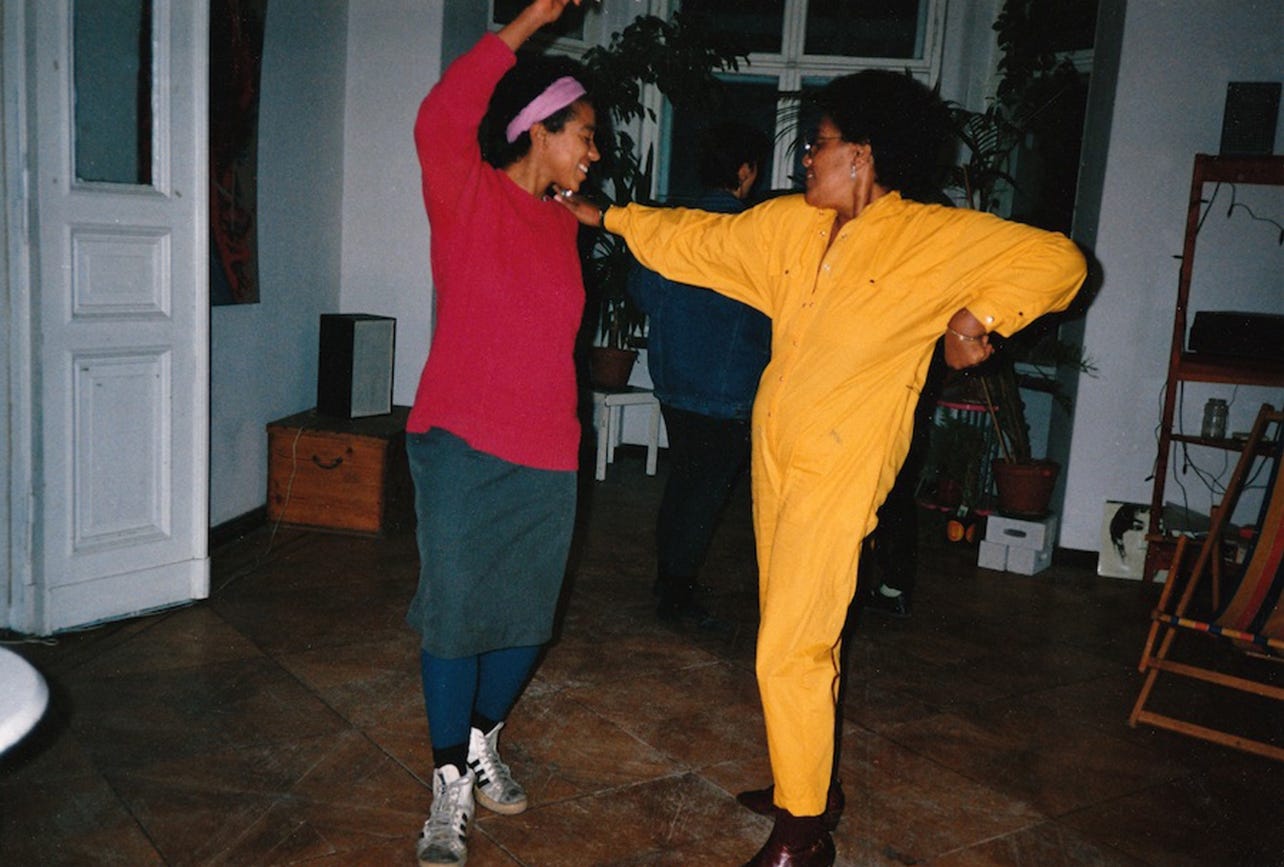
In our kitchen, we have a photo of her dancing alongside another Black femme, joy filling the space between them. She is dressed in a monochromatic yellow jumpsuit, arms outstretched in front of her. Though her face is turned away from the camera, you can still see her smile from behind, cheekbones pointed to the high Heavens.
I hung that picture as a reminder that none of us are only one thing: each of us ordinary, but capable of the extraordinary all the same. And to me, Audre Lorde’s writing is nothing shy of extraordinary. Her Cancer Journals found me in the depths of my grief and gave me the ballast I needed to cope with the sudden loss of my grandmother to Stage IV cancer a few years ago.
I bring up Audre Lorde here because she wrote with such precision about power, positionality, and difference. And she also loved and parented alongside a white woman. In many folks’ eyes, this troubles her legacy.
I’m not seeking justification for my closeness to white people through Audre Lorde’s life. Her life and writing don’t grant me absolution for my choices. If anything, they add complexity to the tension that lives inside me.
At times, I’ve reached for Audre Lorde’s romantic partnership as evidence that intimacy with whiteness can be made less harmful through its rejection, through shared values and intention. One of my absolute favorite stories about her comes from the 1979 National Book Award Ceremony5. She was nominated alongside Adrienne Rich and Alice Walker, and rather than compete with one another, the three of them decided to write a joint statement. Read by Rich on stage, with Lorde standing beside her, they called out the white feminists in the room for behaving as the foot soldiers of white supremacy.
Stories like that set my soul ablaze. In the spirit of Audre Lorde, my late Gramma, Ray Bone, my Mama, Sheila Bone, my sister, Tiffany Bone, my wife, Kelz, and so many other Black women, I will speak truth to whiteness until I am blue in the face.
But I also wonder - what did it cost Audre Lorde to live at the intersection of her radical values and her love of a white woman. I’ll never know how she reconciled that within herself, because she ain’t here to speak to it. What I do know is that, similar to my wife and friends, Audre Lorde also wouldn’t let me off the hook regarding the impact of my choice to be close to whiteness.
And I wonder whether the thing I call “intimacy” with whiteness is actually:
my willingness to extend emotional labor that can never truly be returned in kind;
my willingness to absorb harm white people are blind to while teaching them how to show up for me;
my willingness to disappear parts of myself to be more palatable, to avoid making them uncomfortable, or worse, making them uncomfortable and then soothing them through it;
and most importantly, my willingness to allow the harmful impacts of whiteness to spill onto other Black and Brown folks in my relational ecosystem who do not feel safe consenting to the same level of closeness to whiteness that I do.
As far as I know from reading her work, Audre Lorde never used her marriage to advocate for flattening our differences in the name of intimacy. She did not pretend that love could erase power or harm. Instead, she named how our differences, and the material consequences attached to them, are always in the room with us.
Sitting with Audre Lorde’s work alongside the words of folks in my community forces me to explore not simply what I believe is possible, but the actual impact of my actions right now - on myself, and those around me.
It Matters Not If It’s True, It Matters If It Is Helpful
Recently, I asked my sweet friend, rae, whether they believed white people could truly subvert their relationship to whiteness in a real, material way. In their beautiful, life-coachy way, rae told me that belief itself cannot be verified, “unlike with vaccines effectiveness in fighting disease.” (rae never misses a chance to insert some levity in our philosophical debates and that’s why I cherish our friendship.) They added, “What matters is not whether I [or you] believe it is true, but whether I [or you] believe it is helpful.”
It has always been helpful for me to believe that white folks can meaningfully turn away from whiteness.
Back in 2019, I joined a grassroots organization in Durham whose campaign-focus at the time revolved around mitigating the displacement of Black legacy residents and increasing access to affordable housing. The majority of folks in that organization were white. That summer, we spent hours upon hours, in 100-degree heat, knocking on doors and asking Black and Brown folks what they needed and what they believed had to change. It was fucking grueling, thankless work. But we helped get a $95 million affordable housing bond passed in that year’s municipal election.
Working shoulder-to-shoulder with white folks in pursuit of a liberated future for Black and Brown communities changed something in me at a molecular level. I had never, not once in my entire fucking life, experienced a felt sense of safety in the presence of white folks until then.
Because our identities are not fixed, because we are scripted into race, gender, religion without our consent, I began to believe in my body that any of us could be redeemed through the active rejection of those colonial scripts, that we could choose a politic of Queerness instead.
On most days, hope and imagination are the only things enabling this burned-out bodymind to get out of bed in the morning. This world feels profoundly incongruent with my existence, and it is getting harder each day to suspend my disbelief and participate in it the way I’m expected to. When I say I don’t give a fuck about nothing but gettin’ free - I mean it with every bone in my body, even when I’m fumbling toward that freedom imperfectly.
I needed to believe that white folk could do better, because if it’s possible for white folks to reject whiteness in pursuit of new worlds, then maybe the rest of us stand a chance at truly living, rather than just fighting for our lives.
But here’s the part I am being asked not to ignore anymore:
at some point, my belief in white folks’ redemption became my little way of holding onto hope without fully acknowledging the cost of closeness to whiteness right now.
Shit, even as I write this, I am self-monitoring. I wonder how these words will land on the white readers with whom I share, or have shared, intimate connections.
Ain’t that some shit, dog?
Whiteness manages to make a withdrawal from me even as I explore the cost of closeness to it. And sadly, I am a contortionist. That shit is in me. By that shit, I mean internalized white supremacy.
W.E.B. Du Bois wrote about double consciousness6, the two-fold self-perception experienced by Black folks in a white supremacist society. There is the core self I know myself to be: creative, playful, calm, critical, curious, compassionate. And then there is who I become under the gaze and burden of whiteness: quieter, meek, small, hypervigilant.
I don’t know what’s going to replace my belief that white people can queer their relationship with whiteness, or that I can exist in deep intimacy with them without putting my own head in a guillotine.
This belief has sustained me for a few years now, so letting it go of it lands on my bodymind as grief.
What Is Helpful Now
I have a whiteness problem.
But I think we all do—especially white people. The impact is different, and our responsibility is different, depending on our positionality. But each of us has to decide how to reconcile this throughline that cuts across all of our lived experiences. And if we’re lucky, we get to do that alongside people we love and trust—people who share our vision of a liberated future and are willing to hold our feet to the fire when we need it.
Whiteness is a structure, and white people are the living embodiment of that structure. As such, I see now that whiteness can never be made neutral through queerness, goodness, or intention.
When I stretch my radical imagination to include white people who have yet to meaningfully betray whiteness, I lose something.
When I do so with white folks who are trying, but inevitably falling short, I still lose something.
I’ve been quietly ignoring that loss.
Also, closeness to whiteness has met real needs for me: to be witnessed in my queerness, to feel less alone in my radical values, to have access to more play. My white friends make genuine efforts to show up for me with care. I know this to be true.
But what I am being asked to confront, and move from, is the fact that my access to those things is bound to whiteness in the first place. That costs me something. It costs all of us something.
A white friend taught me how to DJ. A beautiful gesture. It’s something I’ve wanted to do my entire life. My older brother is a literal rapper. My grandparents owned hundreds of vinyl records. And yet, my entry point into this historically Black art form came through a white person.
What does that mean?
For me? For all of us?
The way whiteness functions in this world fills my body with white-hot rage. And still, I’ve been shrinking myself to maintain the belief that whiteness can be redeemed. Whether that’s true or not remains to be seen. But in the meantime, I have to move with more discernment.
When I read Audre Lorde, I feel witnessed in my loneliness, my sadness, and my contradictions. I also feel empowered. From what I know of her life and work, she understood that even in the face of complexity and harm, we are never absolved of agency nor responsibility.
All I can do is arrive at my beliefs and actions honestly and with rigor, and atone when I misstep.
That feels like something she would recognize.
I first heard the term “relational ecosystem” from Mel Cassidy’s "Radical Relating: A Queer and Polyamory-Informed Guide to Love Beyond the Myth of Monogamy”
this language came from Natalie Y. Gutiérrez’s book, “The Pain We Carry”
I was assigned male at birth (AMAB) and now identify as trans nonbinary.
Audre Lorde, Adrienne Rich, and Alice Walker - 1971 Book Award Ceremony
I appreciate you writing and sharing this piece with us. I love the questions you’re asking yourself and the vulnerability of you navigating through and to the answers that resonate with your experience. I find it very caring and loving how the people around you have been opening space with you to explore that as well.
I have been moving through similar sentiments myself—maybe I’ll write about it too some day.
A prayer of rage at the altar of hope. Thank you.